




7min read
Digital public infrastructure is transforming how governments deliver essential services. Yet, making a government service available online does not necessarily mean the experience is seamless.
Imagine applying for a public service online, only to be asked to upload documents that another government department has already verified. Despite the digital interface, the process still involves repeated submissions, manual verification, and unnecessary delays.
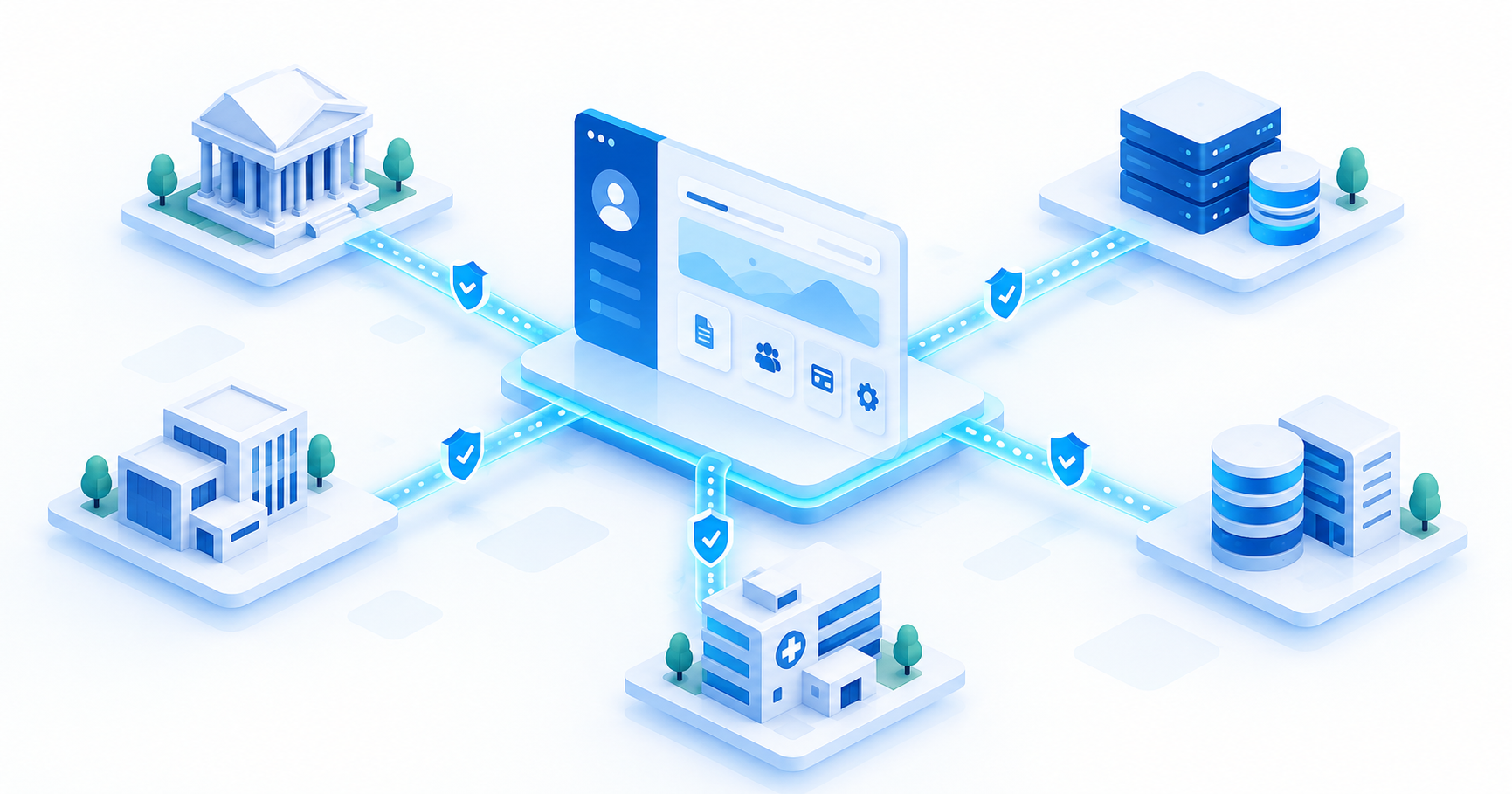
This is where data interoperability becomes essential. By enabling secure data exchange between authorised institutions, governments can reduce duplication, improve coordination, and deliver more connected public services.
The challenge of digital government is no longer simply bringing services online. It is ensuring the systems behind them can work together.
What Is Data Interoperability in Digital Government?
Data interoperability is the ability of different information systems to exchange, interpret, and use data securely.
In government, this allows institutions to verify or retrieve information from authorised sources without requiring citizens to provide the same information repeatedly.
For example, a department processing a public assistance application may need to verify an applicant’s identity or eligibility. Rather than requesting additional documentation, the department could securely verify the required information through an authorised connection with the institution maintaining those records.
This does not mean every government department needs access to every database. Effective interoperability depends on clear data ownership, defined permissions, and controlled information exchange.
According to the World Bank, digital identity, digital payments, and trusted data sharing are foundational components of digital public infrastructure.
These components become more valuable when they support connected services rather than operating independently.
Why Is Data Interoperability Important for Public Services?
Citizens rarely think about which government department owns a particular record. They simply expect a service to work.
However, a single public-service journey may involve several institutions, each operating its own systems, databases, and procedures.
When those systems cannot communicate, the responsibility for connecting them often falls on citizens and government employees.
Applicants may need to submit the same information multiple times, while officials manually verify documents or coordinate approvals across departments.
Data interoperability can help address these inefficiencies by enabling institutions to:
- Reduce duplicate data collection and manual processing.
- Verify information from authoritative sources.
- Improve coordination across departments.
- Support faster and more consistent service delivery.
- Create connected experiences across multiple public services.
The OECD’s Digital Government Outlook 2026 highlights the importance of integrating individual digital services into coherent journeys across institutional boundaries.
Its findings also reveal a gap between infrastructure and implementation. While 83% of the 36 OECD countries surveyed have government data interoperability systems, adoption across institutions remains uneven.
Having the technology in place is therefore only part of the challenge. Institutions must also use it effectively.
How Does Secure Data Exchange Work Between Government Departments?
Secure data exchange enables authorised systems to request, verify, or transfer information while maintaining appropriate safeguards.
This commonly involves APIs, integration platforms, agreed data standards, and authentication mechanisms.
Consider a citizen applying for a government service that requires identity verification.
The application system could send an authorised verification request to the institution responsible for identity records. That institution could then return the specific confirmation required to continue processing the application.
The requesting department may not need access to the underlying identity database or the applicant’s complete record.
This illustrates why effective platform integration is important. Systems must be designed around how information moves, which institutions control it, and what permissions apply.
Secure exchange also requires encryption, access controls, monitoring, and audit trails. These safeguards help protect information and maintain institutional accountability.
What Is the Once-Only Principle in Digital Government?
The once-only principle is based on a straightforward idea: citizens and businesses should not have to repeatedly provide information that government institutions already hold, where lawful reuse is possible.
Instead of collecting the same documents for different services, institutions can verify existing information through authorised exchanges.
Estonia provides a well-known example of this approach.
Its X-Road infrastructure enables independently managed public and private information systems to exchange data securely. Institutions can maintain responsibility for their own records while supporting services that require information from multiple sources.
The European Union has also developed a Once-Only Technical System to support the exchange of official evidence for certain cross-border administrative procedures.
These examples demonstrate that reducing repeated paperwork does not require unrestricted access to government records.
The once-only principle depends on appropriate legal arrangements, security requirements, and clearly defined purposes for sharing information.
Does Data Interoperability Require a Central Government Database?
No. Interoperability does not necessarily require government institutions to combine their information into a single database.
Different departments can retain responsibility for the records they maintain while exchanging the information or verification results necessary for a particular service.
This approach relies on identifying authoritative data sources and creating reliable connections between systems.
For example, an identity authority may remain responsible for identity records, while another institution manages licensing information.
When a service requires information from both, secure exchange mechanisms can support the necessary verification without duplicating entire databases.
However, technical connections alone are insufficient.
Successful enterprise systems integration also requires clear data definitions, compatible standards, reliable workflows, and governance arrangements.
What Makes Government Systems Truly Interoperable?
Interoperability is not simply about connecting one system to another. It requires several elements to work together.
Common standards: Institutions need consistent data definitions, formats, and communication protocols so exchanged information can be interpreted accurately.
Data ownership: Each record needs an authoritative source responsible for maintaining its accuracy and resolving inconsistencies.
Access permissions: Information must be available only to authorised parties for legitimate purposes, with appropriate privacy and security safeguards.
Status and exception handling: Systems need to communicate whether a request was successful and what happens when information is missing, incorrect, or unavailable.
Institutional governance: Departments need clear agreements covering responsibilities, data-sharing conditions, operational accountability, and dispute resolution.
The GovStack initiative promotes reusable digital building blocks to support interoperable government services.
Rather than designing an entirely new integration for every service, governments can establish shared capabilities that support multiple use cases.
This is why effective enterprise architecture planning matters. Integration requirements, data flows, access controls, and governance should be considered before systems are built or expanded.
Why Does Data Interoperability Matter for Pakistan?
Pakistan’s evolving digital-government agenda makes interoperability particularly relevant.
The Digital Nation Pakistan Act, 2025 established the Pakistan Digital Authority and provides for a National Digital Masterplan covering digital governance, the digital economy, and digital society.
As Pakistan advances its digital initiatives, coordination across federal, provincial, and local institutions will be an important consideration.
Government services often involve multiple departments, separate data systems, and institutional responsibilities that cannot be addressed through individual online portals alone.
Building interoperable systems could help institutions verify information more efficiently, reduce repeated documentation, and provide citizens with more consistent service experiences.
However, this requires more than introducing new technology. Institutions must also address existing infrastructure, data quality, information security, legal requirements, and governance responsibilities.
For Pakistan, the opportunity lies in designing digital services that function as connected journeys while preserving appropriate institutional control over information.
Building Connected Services, Not Just Digital Platforms
The future of digital government is not simply about launching more portals or digitising more forms.
It is about ensuring that the systems supporting those services can communicate securely, reliably, and responsibly.
Effective digital public infrastructure depends on institutions understanding which information they hold, how it should move, who can access it, and how connected services should operate.
At Centangle, our approach to enterprise systems and integration focuses on connecting technology, workflows, and information around the needs of the people and organisations using them.
Because meaningful digital transformation is not measured only by how many services are available online.
It is measured by how effectively those services work together.
Key Takeaways
- What Is Data Interoperability in Digital Government?
- Why Is Data Interoperability Important for Public Services?
- How Does Secure Data Exchange Work Between Government Departments?
- What Is the Once-Only Principle in Digital Government?
Final Thoughts
Lasting transformation comes from clear goals, honest process design, and technology chosen to support how your teams actually work—not the other way around. If this article resonated, we can help you translate insight into a practical roadmap.